Next.js starter for 2026: create-next-app vs paid kits
Compare create-next-app, free starters, and paid Next.js kits in 2026. See what a real starter should include and when buying one actually saves you time.
 FekriAugust 19, 20263 min read
The real decision
As of 19 August 2026, create-next-app ships App Router, TypeScript, Tailwind, and the @/* alias by default. The official CLI docs were last updated on 10 August 2026. Source: Next.js create-next-app reference.
That is why this query is awkward. Google is not asking for another fake "best 7 starters" list. The SERP is mostly official docs, Vercel templates, GitHub starters, and Reddit. People are trying to answer one question: should I start with create-next-app, grab a starter, or pay for a fuller kit because I need to ship this week?
If you want a roundup of actual products, read my separate Next.js boilerplate roundup. This page is the chooser.
Next.js starter vs create-next-app
The official CLI is better than people give it credit for.
Right now, npx create-next-app@latest gets you a clean App Router project with TypeScript, Tailwind, and sane defaults. For a landing page, content site, internal tool, or anything where you want to hand-pick every service, that is enough. I would start there.
Where it stops being enough is when "starting the app" is not the real job anymore.
The expensive part of shipping a SaaS is usually everything around the app:
- auth and protected routes
- database schema and migrations
- billing and webhooks
- email flows
- analytics
- admin states
- file uploads
- AI model wiring, if the product uses models
That is the gap a real starter is supposed to close.
If a so-called starter only saves you the first 15 minutes, it is not a starter. It is a prettier create-next-app.
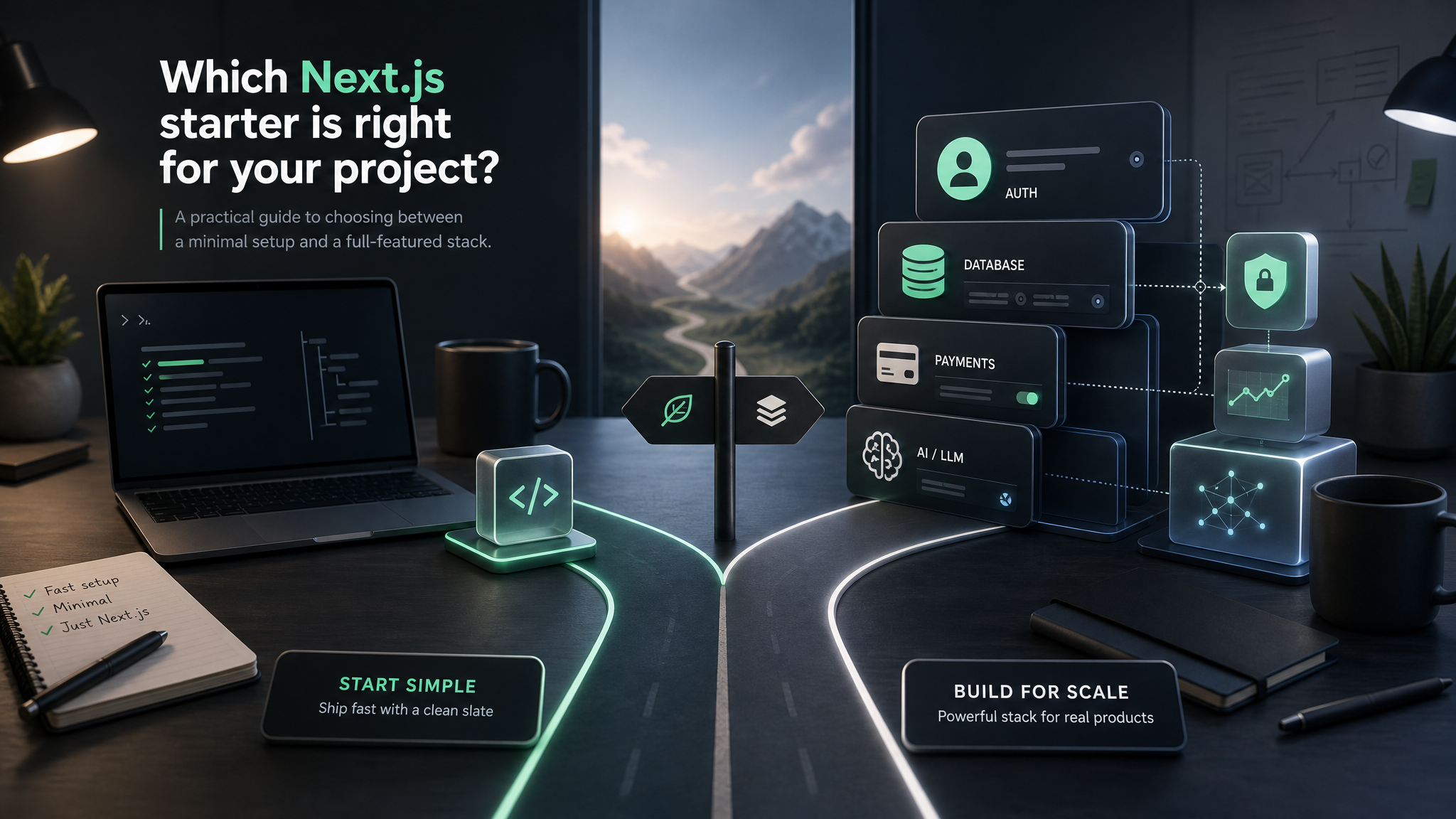
This is the clean comparison I use:
| Option | Best fit | What you get on day 1 | What you still build yourself | Cost |
|---|---|---|---|---|
create-next-app | Content sites, internal tools, simple products, learning Next.js properly | App Router, TypeScript, Tailwind, import alias, clean project structure | Auth, database, billing, email, analytics, admin flows, AI integrations | Free |
| Paid starter template | Founders who already know the product they want to ship and want common SaaS setup done | Usually auth, UI, database choice, payments, basic dashboard, docs | Product-specific flows, data model edge cases, migration cleanup, long-term conventions | Varies |
| Full kit like AnotherWrapper | AI SaaS builders who want the product layer wired, not only the scaffold | Auth, billing, model layer, 8 finished AI app patterns, landing pages, blog, AI-ready foundation | Your actual product logic, branding, and whatever makes the business different | $249 once |
There is also a good free middle ground: the official nextjs/saas-starter repo on GitHub. I like it for people who want auth, Stripe, and a dashboard without paying yet. I do not think it replaces a fuller kit if you need a whole product stack fast, but it is a serious option.
What a paid Next.js starter should include
In 2026, a paid Next.js starter should earn its price by deleting boring work you were going to do anyway.
My checklist is simple:
- App Router and TypeScript are table stakes. If a paid starter still feels like a dressed-up demo, pass.
- Auth has to be real. I want protected routes, session handling, user states, and role-aware flows, not only a login button.
- The database layer has to exist before I touch product code. That means schema, migrations, and a path for permissions.
- Payments have to include the annoying parts, especially webhooks, plan state, and upgrade or cancel logic.
- Email and analytics should already be in place. Every app ends up needing them.
If the product is AI-native, I add one more requirement: a model layer I can actually ship with. Provider switching, usage tracking, and sane places to plug in prompts matter more than fancy marketing copy. If model costs are part of your build plan, check the live numbers in /tools/llm-pricing before you commit to a stack.
When create-next-app is enough
Use the official CLI if you are in one of these buckets:
- you are learning Next.js and want to understand each moving part
- you are building a marketing site, docs site, or small internal tool
- you have strong stack opinions and hate removing somebody else's abstractions
- you are still validating the idea and do not even know whether billing belongs in version 1
That last one matters.
I see founders buy starters too early, then spend 2 days bending them back into the simpler app they should have started with. That is a dumb tax. If your product is still a sketch, keep the setup small.
When paying is rational
Paying for a starter makes sense when the product direction is already clear and the repetitive work is now the bottleneck.
That usually means:
- you know you need auth
- you know you need a database
- you know somebody will pay
- you know you need billing and email soon
- you care more about time than about the purity of building every layer yourself
At that point, buying time is normal.
The best paid starters do not win because the code is magical. They win because they compress 1 to 3 weeks of fiddly setup into one afternoon. That is the whole deal.
Where AnotherWrapper fits
AnotherWrapper is the right call when you already know you are building an AI SaaS and you want more than a blank shell.
It is not the tool I would hand to somebody learning Next.js for the first time. I would tell that person to use create-next-app and keep the surface area small.
But if you want auth, billing, and the model layer wired from day 1, plus 8 finished AI apps you can borrow patterns from, then a fuller kit starts making sense. AnotherWrapper is $249 once, and there is a 30-day refund if it does not save you time.
That is the frame I care about: does the kit remove real setup pain, or does it just hand you a nicer folder tree?
From the maker
Need the full stack, not the blank scaffold?
AnotherWrapper is built for AI SaaS teams that want auth, billing, and the model layer ready on day 1. You get 8 finished AI apps, a one-time $249 price, and a 30-day refund if it is not the right fit.
“You've turned 3 months of work into 3 weeks man. Worth every penny.”
Kamara
·Indie Maker
Verified on DiscordTrusted by 2,000+ founders · One-time payment · Lifetime updates
Frequently asked questions
What is the difference between create-next-app and a Next.js starter?
create-next-app is the official CLI and gives you a clean Next.js app. A Next.js starter adds the product layers you would otherwise wire yourself, such as auth, database, payments, email, analytics, and sometimes AI integrations.
Is create-next-app enough for most projects?
create-next-app is enough for content sites, marketing sites, internal tools, and custom apps where you want full control over every integration and do not mind wiring the rest yourself.
What should a paid Next.js starter include in 2026?
In 2026, a paid Next.js starter should include App Router, TypeScript, auth, database setup, payments, email, analytics, and deployment-ready app structure. If it skips those, it is mostly a theme.
Should I use the official nextjs/saas-starter?
The official nextjs/saas-starter is a strong free middle ground when you want auth, Stripe, and a dashboard but still plan to finish the product infrastructure yourself.
When is a paid kit worth it?
A paid kit is worth it when it deletes one to three weeks of setup on a product you actually plan to ship, not when you are still learning Next.js or testing a one-page idea.
Where does AnotherWrapper fit?
If you are shipping an AI product, AnotherWrapper is the kit I would buy. Auth, billing, model integrations, and 8 finished AI apps are already in the repo. $249 once, 30-day refund.
Stay ahead of the curve
Weekly insights on AI tools, comparisons, and developer strategies.

Fekri
Building tools for the next generation of AI-powered startups. Sharing what I learn along the way.
Related
Tags
Continue reading
You might also enjoy
AI Wrapper: What It Is, Examples & How to Build One
Learn what an AI wrapper is, how ChatGPT wrappers work, what they cost, and how to build one with auth, payments, credits, and analytics.
 Fekri
Fekri
Best SaaS Boilerplates in 2026: Next.js Starter Kits Compared
An honest comparison of 8 SaaS boilerplates and Next.js starter kits in 2026. Features, pricing, AI integrations, and what actually matters when picking one.
Fekri
Next.js Boilerplates in 2026: What I'd Actually Buy
The Next.js boilerplate I'd actually buy in 2026 is AnotherWrapper. Here's how ShipFast, Supastarter, Makerkit, and the free options compare, and where they lose.
Fekri